
Health Conditions More Common Among Young Males
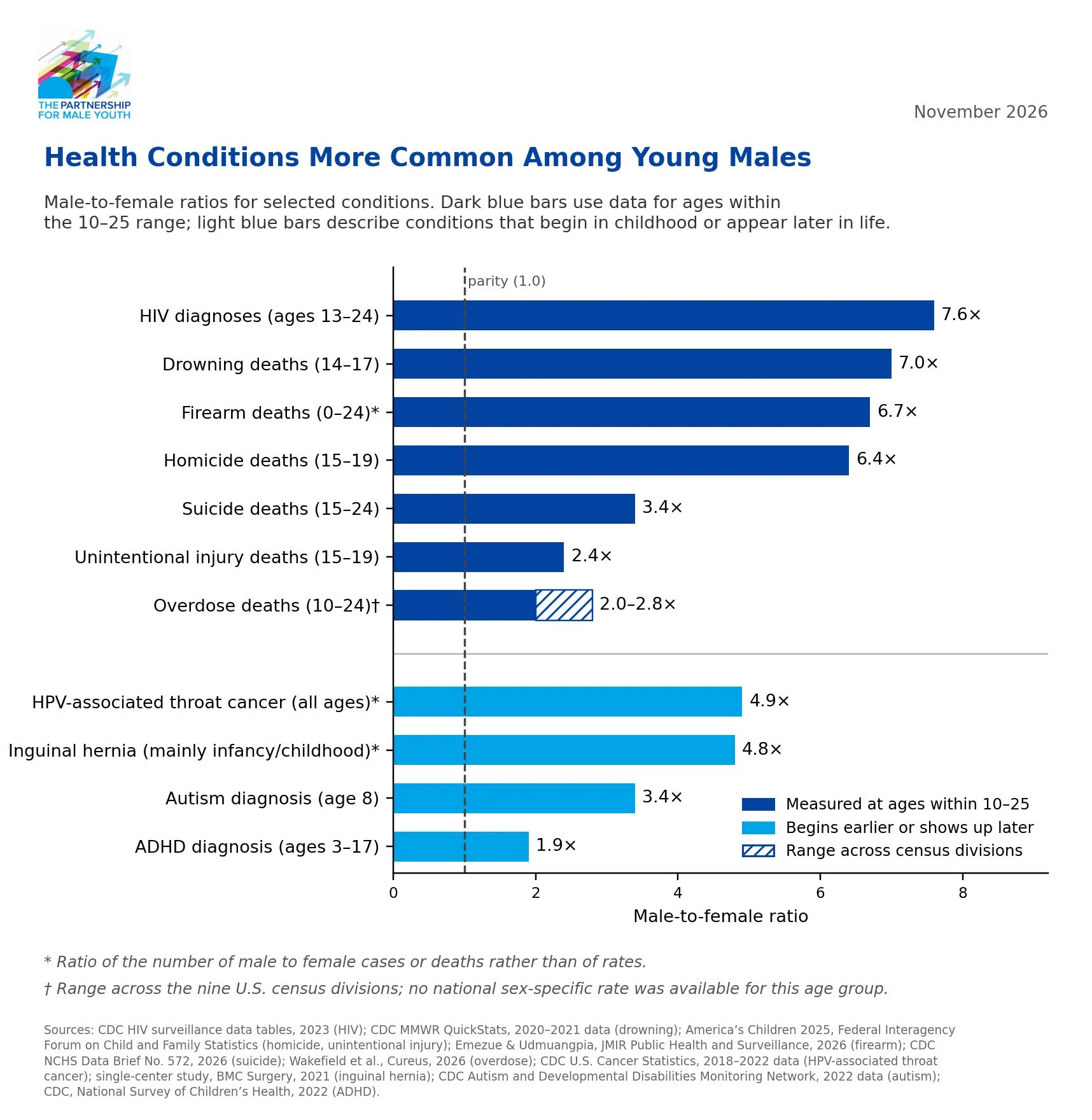
Male-to-female ratios for eleven health conditions show young males carrying the greater burden in every case, from roughly twice the rate of overdose and accidental injury deaths to nearly eight times the rate of new HIV diagnoses. Dark blue bars reflect ages 10–25; light blue bars show male-skewed conditions that begin in childhood or appear later in life.
Sources
Measured at ages within 10–25
HIV diagnoses (ages 13–24), 7.6×. CDC HIV surveillance data tables, Table 7a (2023 data), posted with the 2024 data release (published May 18, 2026). Diagnosis rates of 23.6 per 100,000 for males and 3.1 for females at ages 13–24 (6,310 male and 807 female diagnoses). https://stacks.cdc.gov/view/cdc/256154/cdc_256154_DS_EXCEL.pdf
Drowning deaths (ages 14–17), 7.0×. CDC, MMWR QuickStats, August 2023 (2020–2021 data): 1.4 per 100,000 for males and 0.2 for females. https://www.cdc.gov/mmwr/volumes/72/wr/mm7234a7.htm
Firearm deaths (ages 0–24)*, 6.7×. Emezue C, Udmuangpia T. JMIR Public Health and Surveillance, 2026 (2018–2024 data): of 65,472 firearm deaths, 13% were female. https://doi.org/10.2196/96931
Homicide deaths (ages 15–19), 6.4×. America’s Children 2025, Federal Interagency Forum on Child and Family Statistics, table PHY8.B (2023 data): 20.4 per 100,000 for males and 3.2 for females. https://www.childstats.gov/americaschildren/tables/phy8b.asp
Suicide deaths (ages 15–24), 3.4×. CDC, NCHS Data Brief No. 572, September 2026 (2024 data): 20.2 per 100,000 for males and 5.9 for females. https://www.cdc.gov/nchs/products/databriefs/db572.htm
Unintentional injury deaths (ages 15–19), 2.4×. America’s Children 2025, Federal Interagency Forum on Child and Family Statistics, table PHY8.B (2023 data): 31.1 per 100,000 for males and 13.2 for females. Same source as homicide. https://www.childstats.gov/americaschildren/tables/phy8b.asp
Overdose deaths (ages 10–24)†, 2.0–2.8×. Wakefield J, et al. Cureus, 2026 (2020–2023 data; range calculated from the study’s regional tables).https://doi.org/10.7759/cureus.109677
Begins earlier or shows up laterHPV-associated throat cancer (all ages)*, 4.9×. CDC, “Cancers Linked with HPV Each Year,” U.S. Cancer Statistics, updated December 2025 (2018–2022 data: 18,776 male and 3,809 female cases per year). https://www.cdc.gov/cancer/hpv/cases.html
Inguinal hernia (mainly infancy and childhood)*, 4.8×. Wang K, et al. BMC Surgery, 2021: 12,190 children treated at Beijing Children’s Hospital, 2007–2019. A single-center hospital series, not population-based; the authors note their ratio is higher than the roughly 2.5 to 1 reported elsewhere. https://pmc.ncbi.nlm.nih.gov/articles/PMC7849117
Autism (age 8), 3.4×. CDC ADDM Network, MMWR Surveillance Summaries, 2025 (2022 data): 49.2 per 1,000 boys and 14.3 per 1,000 girls. https://www.cdc.gov/mmwr/volumes/74/ss/ss7402a1.htm
ADHD (ages 3–17), 1.9×. CDC ADHD data page, reporting the 2022 National Survey of Children’s Health: 15% of boys and 8% of girls ever diagnosed. https://www.cdc.gov/adhd/data/index.html