
Health Risks Specific to and Concentrated Among Young Males
A briefing from The Partnership for Male Youth | October 2026
Young males ages 10–25 face two kinds of health risk that young females do not share in the same way. The first, and by far the larger in population terms, is a set of conditions that affect both sexes but fall much more heavily on young males. The second is a shorter list of conditions that, because of male anatomy or the single X chromosome, occur only or almost only in males. A third group of male-skewed conditions begins in early childhood or produces its harm later in life, and these are noted separately. Wherever possible, the figures below are for ages within the 10–25 range, and each figure gives the ages it covers.
Conditions concentrated among young males
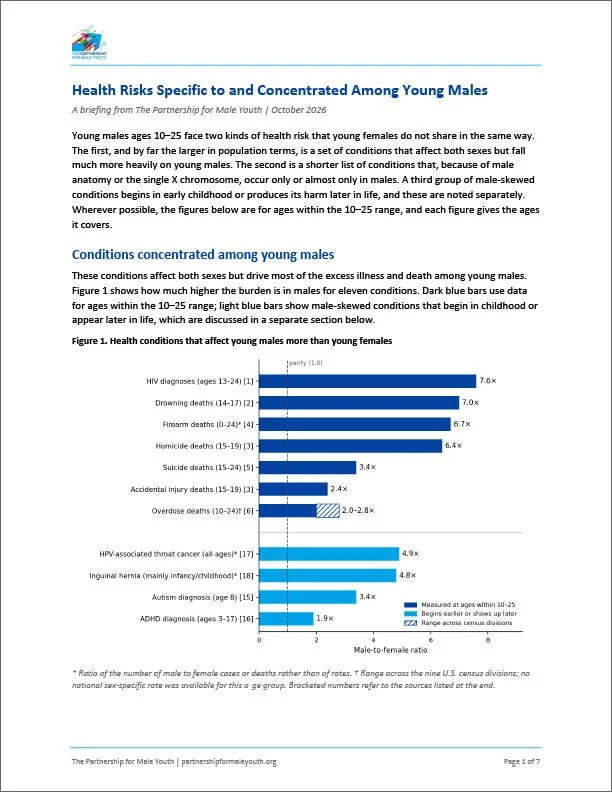
These conditions affect both sexes but drive most of the excess illness and death among young males. Figure 1 shows how much higher the burden is in males for eleven conditions. Dark blue bars use data for ages within the 10–25 range; light blue bars show male-skewed conditions that begin in childhood or appear later in life, which are discussed in a separate section below.
Figure 1. Health conditions that affect young males more than young females

-
Measured at ages within 10–25
HIV diagnoses (ages 13–24), 7.6×. CDC HIV surveillance data tables, Table 7a (2023 data), posted with the 2024 data release (published May 18, 2026). Diagnosis rates of 23.6 per 100,000 for males and 3.1 for females at ages 13–24 (6,310 male and 807 female diagnoses). https://stacks.cdc.gov/view/cdc/256154/cdc_256154_DS_EXCEL.pdf
Drowning deaths (ages 14–17), 7.0×. CDC, MMWR QuickStats, August 2023 (2020–2021 data): 1.4 per 100,000 for males and 0.2 for females. https://www.cdc.gov/mmwr/volumes/72/wr/mm7234a7.htm
Firearm deaths (ages 0–24)*, 6.7×. Emezue C, Udmuangpia T. JMIR Public Health and Surveillance, 2026 (2018–2024 data): of 65,472 firearm deaths, 13% were female. https://doi.org/10.2196/96931
Homicide deaths (ages 15–19), 6.4×. America’s Children 2025, Federal Interagency Forum on Child and Family Statistics, table PHY8.B (2023 data): 20.4 per 100,000 for males and 3.2 for females. https://www.childstats.gov/americaschildren/phys8.asp
Suicide deaths (ages 15–24), 3.4×. CDC, NCHS Data Brief No. 572, September 2026 (2024 data): 20.2 per 100,000 for males and 5.9 for females. https://www.cdc.gov/nchs/products/databriefs/db572.htm
Accidental (unintentional) injury deaths (ages 15–19), 2.4×. America’s Children 2025, Federal Interagency Forum on Child and Family Statistics, table PHY8.B (2023 data): 31.1 per 100,000 for males and 13.2 for females. Same source as homicide. https://www.childstats.gov/americaschildren/phys8.asp
Overdose deaths (ages 10–24)†, 2.0–2.8×. Wakefield J, et al. Cureus, 2026 (2020–2023 data; range calculated from the study’s regional tables). https://doi.org/10.7759/cureus.109677
Begins earlier or shows up later
HPV-associated throat cancer (all ages)*, 4.9×. CDC, “Cancers Linked with HPV Each Year,” U.S. Cancer Statistics, updated December 2025 (2018–2022 data: 18,776 male and 3,809 female cases per year). https://www.cdc.gov/cancer/hpv/cases.html
Inguinal hernia (mainly infancy and childhood)*, 4.8×. Wang K, et al. BMC Surgery, 2021: 12,190 children treated at Beijing Children’s Hospital, 2007–2019. A single-center hospital series, not population-based; the authors note their ratio is higher than the roughly 2.5 to 1 reported elsewhere. https://pmc.ncbi.nlm.nih.gov/articles/PMC7849117
Autism (age 8), 3.4×. CDC ADDM Network, MMWR Surveillance Summaries, 2025 (2022 data): 49.2 per 1,000 boys and 14.3 per 1,000 girls. https://www.cdc.gov/mmwr/volumes/74/ss/ss7402a1.htm
ADHD (ages 3–17), 1.9×. CDC ADHD data page, reporting the 2022 National Survey of Children’s Health: 15% of boys and 8% of girls ever diagnosed. https://www.cdc.gov/adhd/data/index.html
Ratio of the number of male to female cases or deaths rather than of rates.
† Range across the nine U.S. census divisions; no national sex-specific rate was available for this age group.
HIV. In 2023, the HIV diagnosis rate among young people ages 13–24 in the United States was 23.6 per 100,000 for males and 3.1 for females. In all, 6,310 males and 807 females in this age group were diagnosed (88.7% male).¹
Drowning. Among ages 14–17, the unintentional drowning death rate was 1.4 per 100,000 for males and 0.2 for females in 2020–2021.²
Homicide. Among ages 15–19 in 2023, the homicide death rate was 20.4 per 100,000 for males and 3.2 for females, and for males homicide exceeded suicide as a cause of death.³
Firearm deaths. Of the 65,472 firearm deaths among people ages 0–24 in 2018–2024, 87% were male. Deaths before age 10 are a small share of the total.⁴ Firearms account for most homicides and many suicides at these ages, so this bar overlaps with those two.
Suicide. Young females attempt suicide more often, but young males die by suicide at more than three times the rate: 20.2 per 100,000 for males ages 15–24 in 2024, compared with 5.9 for females.⁵ Much of the difference reflects method, especially firearms.
Accidental (unintentional) injury. The leading cause of death at these ages. Among ages 15–19 in 2023, the rate was 31.1 per 100,000 for males and 13.2 for females.³ Drowning and most overdose deaths fall within this category.
Overdose. In every U.S. census division in 2020–2023, unintentional overdose death rates among males ages 10–24 were 2.0 to 2.8 times those among females, although the gap has been narrowing.⁶
Other conditions concentrated among young males
Substance use. Among adolescents ages 12–17, the pattern now runs the other way: 6.8% of boys and 9.9% of girls had a substance use disorder in the past year in 2022–2024. Among all adults 18 and older, males were more likely to have one (21.4% versus 14.6%).⁷ The report does not break out ages 18–25 by sex. In 2017, more high school boys than girls reported ever having used anabolic steroids (3.5% versus 2.4%).⁸
Sports-related injury and concussion. Young males have greater exposure to collision sports, and football carries the highest concussion rates in high school athletics. In sports that both sexes play, however, girls’ concussion rates are higher: 3.35 versus 1.51 per 10,000 athlete exposures in 2013–2018.⁹
HIV and other STIs among young males who have sex with males. Across all ages, male-to-male sexual contact accounted for 65% of new HIV diagnoses in 2024, and among males ages 13–24 diagnosed through this route, 47% were Black.¹⁰ This population, again across all ages, also carries a disproportionate share of syphilis,¹¹ and nearly all cases in the 2022 mpox outbreak occurred among males who have sex with males.¹²
Gynecomastia. In a classic study of 1,855 boys, 38.7% had pubertal gynecomastia, peaking at 64.6% around age 14, and most cases resolved within one to two years.¹³ It can still cause real distress and is sometimes a sign of steroid use or an endocrine disorder.
Constitutional delay of puberty. The most common cause of delayed puberty in both sexes, it accounts for about 65% of delayed puberty in boys versus 30% in girls.¹⁴
Conditions that begin earlier or show up later
The following conditions are concentrated in males, but the figures available describe early childhood or later adulthood rather than ages 10–25. They appear as the light blue bars in Figure 1 and are included because they bear on health during adolescence and young adulthood: autism and ADHD begin in childhood and carry forward, HPV-associated cancer results from infections acquired during these years, and inguinal hernia is noted because it is among the most common male-skewed conditions of childhood.
Autism (measured at age 8). In 2022, 49.2 per 1,000 boys and 14.3 per 1,000 girls age 8 were identified with autism, a ratio of 3.4 to 1. The ratio has narrowed as identification in girls has improved.¹⁵
ADHD (ages 3–17). In 2022, 15% of boys and 8% of girls ages 3–17 had ever been diagnosed with ADHD, a ratio of about 1.9 to 1. As with autism, the gap is narrowing.¹⁶
HPV-associated throat cancer (all ages). In 2018–2022, an average of 22,585 HPV-associated oropharyngeal cancers were diagnosed each year in the United States: 18,776 in males and 3,809 in females, a ratio of about 4.9 to 1.¹⁷ These cancers usually appear in midlife, but the infections that cause them are typically acquired in adolescence and young adulthood, which makes HPV vaccination of young males the key prevention point.
Inguinal hernia (mainly infancy and childhood). It occurs several times as often in males; a series of 12,190 children treated at one hospital in Beijing found a male-to-female ratio of 4.8 to 1, higher than the roughly 2.5 to 1 reported in earlier studies.¹⁸
Conditions that occur only in young males
Anatomical conditions
Testicular cancer. The most common cancer in males ages 15–35, so its peak falls squarely in the adolescent and young adult years. It is often curable, and its cells usually respond well to chemotherapy and radiation.¹⁹
Testicular torsion. A surgical emergency whose incidence peaks in adolescence, around puberty.²⁰ Timing is decisive: in one pediatric series, the testicle was saved in 90% of boys who arrived at the hospital within six hours of pain onset, compared with 29% of those who arrived later.²¹ Embarrassment frequently leads to late presentation.
Varicocele. Rare before age 10, it rises during puberty to about 15% of adolescent males, similar to the adult rate, and usually occurs on the left side. It is the most common identifiable cause of male factor infertility and can impair testicular growth.²²
Epididymitis and orchitis. In sexually active young males these are most often caused by chlamydia or gonorrhea.²³ Mumps orchitis remains a concern in under-vaccinated populations.²⁴
Hydrocele, spermatocele, and the after-effects of undescended testis. A history of cryptorchidism raises the risk of both infertility and testicular cancer.²⁵
Penile and foreskin conditions. These include phimosis, paraphimosis, and balanitis,²⁶ as well as hypospadias, which is present from birth in about 1 in 150 boys and can cause problems later in life if untreated.²⁷
Male hypogonadism. Primary causes include Klinefelter syndrome (47,XXY), the most common sex-chromosome disorder in males, affecting about 1 in 660. Many cases are diagnosed late or never, and puberty is often when signs first appear.²⁸ Secondary causes include suppression from anabolic steroid use.
Male infertility factors that begin in adolescence. Varicocele, torsion, and cancer treatment can all affect later fertility. National oncology guidelines call for discussing sperm banking with postpubertal males before cancer treatment,²⁹ which makes fertility preservation a specifically adolescent and young adult issue.
X-linked conditions
Because males have a single X chromosome, one altered gene on it is enough to cause an X-linked recessive condition.³⁰ These conditions are present from birth, but several shape health through adolescence and young adulthood. They include hemophilia A and B, Duchenne and Becker muscular dystrophy, G6PD deficiency, fragile X syndrome (more severe in males), red-green color blindness, and X-linked adrenoleukodystrophy. Survival in Duchenne has improved markedly: median life expectancy reached about 28 years for people born after 1990, so many now reach young adulthood.³¹ Leber hereditary optic neuropathy is not X-linked, but it affects males four to five times as often as females and typically begins in the teens and twenties.³²
Implications
The conditions concentrated among young males are where the population-level burden lies, and most of them, from firearm and drowning deaths to overdose and HIV, are preventable. The conditions unique to young males are relatively uncommon, but they are often missed because young males are less likely than young females to report genital symptoms or to see a health care provider at all.
Notes on the data
The ratios in Figure 1 come from different sources, age bands, and years, and three of them compare numbers of cases or deaths rather than rates. The light blue bars describe ages outside the 10–25 range. They should be read as indicating the size of each disparity, not as a strict like-for-like ranking. Some categories overlap: firearm deaths include most homicides and many suicides, and drowning and most overdose deaths fall within unintentional injury. Where the female rate is very small, as with teen drowning, the ratio is sensitive to rounding. The sources used here do not report sex-specific figures for ages 18–25 alone for substance use disorder or overdose.
Sources
Centers for Disease Control and Prevention. Diagnoses, deaths, and prevalence of HIV in the United States and 7 territories and freely associated states, 2024 [Tables], Table 7a: HIV diagnoses among persons aged 13–24 years, by age at diagnosis and selected characteristics, 2023—United States. Published May 18, 2026; the 2024 release’s tables report 2023 data for this table. doi:10.15620/256154. Available from: https://stacks.cdc.gov/view/cdc/256154/cdc_256154_DS_EXCEL.pdf
Spencer MR, Garnett MF. QuickStats: unintentional drowning death rates of children and adolescents aged 0–17 years, by sex and age group — United States, 2020–2021. MMWR Morb Mortal Wkly Rep. 2023;72(34):936. Available from: https://www.cdc.gov/mmwr/volumes/72/wr/mm7234a7.htm
Federal Interagency Forum on Child and Family Statistics. America’s Children 2025: adolescent injury and mortality (indicator PHY8). Available from: https://www.childstats.gov/americaschildren/phys8.asp
Emezue C, Udmuangpia T. Twenty-five years of firearm homicides and suicides among US children and young adults, 1999 to 2024: intersectional surveillance analysis. JMIR Public Health Surveill. 2026;12:e96931. Available from: https://doi.org/10.2196/96931
Garnett MF, Zehner AM. Changes in suicide rates in the United States from 2023 to 2024. NCHS Data Brief. 2026 Sep;(572):1–12. doi:10.15620/cdc/252473. Available from: https://www.cdc.gov/nchs/products/databriefs/db572.htm
Wakefield J, Sun C, Ramtin S, Castro A, Ilyas AM. Youth and young adult national overdose rates: a descriptive, ecological cross-sectional time-trend analysis of drug overdose mortality in 10-24-year-olds in the United States. Cureus. 2026;18(5):e109677. Available from: https://doi.org/10.7759/cureus.109677
Substance Abuse and Mental Health Services Administration. Substance use disorder in the past year. NSDUH Population Statistics Reports. 2025 Sep;1(3). Available from: https://www.samhsa.gov/data/sites/default/files/reports/rpt56619/2024-nsduh-psr3-sud.pdf
Schneider KE, Webb L, Boon D, Johnson RM. Adolescent anabolic-androgenic steroid use in association with other drug use, injection drug use, and team sport participation. J Child Adolesc Subst Abuse. 2020;29(4–6):246–251. doi:10.1080/1067828X.2022.2052219. Analysis of 2017 national Youth Risk Behavior Survey data. Available from: https://pmc.ncbi.nlm.nih.gov/articles/PMC9762502
Kerr ZY, Chandran A, Nedimyer AK, Arakkal A, Pierpoint LA, Zuckerman SL. Concussion incidence and trends in 20 high school sports. Pediatrics. 2019;144(5):e20192180. Available from: https://pubmed.ncbi.nlm.nih.gov/31615955/
Centers for Disease Control and Prevention. HIV diagnoses, deaths, and prevalence—United States and 7 territories and freely associated states, 2024. Published May 18, 2026. Available from: https://www.cdc.gov/hiv-data/nhss/hiv-diagnoses-deaths-prevalence.html
Centers for Disease Control and Prevention. Sexually transmitted infections surveillance, 2023. Atlanta (GA): CDC; 2024.
Philpott D, Hughes CM, Alroy KA, et al. Epidemiologic and clinical characteristics of monkeypox cases — United States, May 17–July 22, 2022. MMWR Morb Mortal Wkly Rep. 2022;71(32):1018–1022. Available from: https://www.cdc.gov/mmwr/volumes/71/wr/mm7132e3.htm
Nydick M, Bustos J, Dale JH Jr, Rawson RW. Gynecomastia in adolescent boys. JAMA. 1961;178:449–454. Available from: https://jamanetwork.com/journals/jama/article-abstract/332010
Palmert MR, Dunkel L. Delayed puberty. N Engl J Med. 2012;366(5):443–453. Available from: https://doi.org/10.1056/NEJMcp1109290
Shaw KA, Williams S, Patrick ME, et al. Prevalence and early identification of autism spectrum disorder among children aged 4 and 8 years — Autism and Developmental Disabilities Monitoring Network, 16 sites, United States, 2022. MMWR Surveill Summ. 2025;74(SS-2):1–22. Available from: https://www.cdc.gov/mmwr/volumes/74/ss/ss7402a1.htm
Centers for Disease Control and Prevention. Data and statistics on ADHD, citing Danielson ML, Claussen AH, Bitsko RH, et al. ADHD prevalence among U.S. children and adolescents in 2022: diagnosis, severity, co-occurring disorders, and treatment. J Clin Child Adolesc Psychol. 2024;53(3):343–360. Available from: https://www.cdc.gov/adhd/data/index.html
Centers for Disease Control and Prevention. Cancers linked with HPV each year (U.S. Cancer Statistics, 2018–2022 data). Updated December 3, 2025. Available from: https://www.cdc.gov/cancer/hpv/cases.html
Wang K, Tan SS, Xiao Y, et al. Characteristics and treatments for pediatric ordinary and incarcerated inguinal hernia based on gender: 12-year experiences from a single center. BMC Surg. 2021;21:67. Available from: https://pmc.ncbi.nlm.nih.gov/articles/PMC7849117
National Cancer Institute. SEER Training Modules: introduction to testicular cancer—review. Available from: https://www.training.seer.cancer.gov/testicular/intro/review.html
Zhao LC, Lautz TB, Meeks JJ, Maizels M. Pediatric testicular torsion epidemiology using a national database: incidence, risk of orchiectomy and possible measures toward improving the quality of care. J Urol. 2011;186(5):2009–2013. Available from: https://pubmed.ncbi.nlm.nih.gov/21944120/
Ramachandra P, Palazzi KL, Holmes NM, Marietti S. Factors influencing rate of testicular salvage in acute testicular torsion at a tertiary pediatric center. West J Emerg Med. 2015;16(1):190–194. Available from: https://pmc.ncbi.nlm.nih.gov/articles/PMC4307716
Macey MR, Owen RC, Ross SS, Coward RM. Best practice in the diagnosis and treatment of varicocele in children and adolescents. Ther Adv Urol. 2018;10(9):273–282. Available from: https://pmc.ncbi.nlm.nih.gov/articles/PMC6088496
Workowski KA, Bachmann LH, Chan PA, et al. Sexually transmitted infections treatment guidelines, 2021. MMWR Recomm Rep. 2021;70(4):1–187. Available from: https://www.cdc.gov/mmwr/volumes/70/rr/rr7004a1.htm
Centers for Disease Control and Prevention. Mumps. In: Epidemiology and Prevention of Vaccine-Preventable Diseases (Pink Book). 14th ed. Washington (DC): Public Health Foundation; 2021.
Kolon TF, Herndon CDA, Baker LA, et al. Evaluation and treatment of cryptorchidism: AUA guideline. J Urol. 2014;192(2):337–345. (Validity reaffirmed by the AUA in 2025.)
American Academy of Pediatrics Task Force on Circumcision. Male circumcision. Pediatrics. 2012;130(3):e756–e785. (AAP has since marked this technical report as expired.)
Centers for Disease Control and Prevention. About hypospadias. Available from: https://www.cdc.gov/birth-defects/about/hypospadias.html
Groth KA, Skakkebæk A, Høst C, Gravholt CH, Bojesen A. Klinefelter syndrome—a clinical update. J Clin Endocrinol Metab. 2013;98(1):20–30. Available from: https://doi.org/10.1210/jc.2012-2382
Oktay K, Harvey BE, Partridge AH, et al. Fertility preservation in patients with cancer: ASCO clinical practice guideline update. J Clin Oncol. 2018;36(19):1994–2001. Available from: https://pubmed.ncbi.nlm.nih.gov/29620997/
MedlinePlus Genetics. What are the different ways a genetic condition can be inherited? National Library of Medicine. Available from: https://medlineplus.gov/genetics/understanding/inheritance/inheritancepatterns/
Broomfield J, Hill M, Guglieri M, Crowther M, Abrams K. Life expectancy in Duchenne muscular dystrophy: reproduced individual patient data meta-analysis. Neurology. 2021;97(23):e2304–e2314. Available from: https://pmc.ncbi.nlm.nih.gov/articles/PMC8665435/
Yu-Wai-Man P, Chinnery PF. Leber hereditary optic neuropathy. In: GeneReviews [Internet]. Seattle (WA): University of Washington; updated 2021 Mar 11. Available from: https://www.ncbi.nlm.nih.gov/books/NBK1174/